It is a Tuesday morning and you just signed your first three clients. You did the consults, walked everyone through the agreement, and all three said yes. Then you sit down to send the first invoice and it lands on you: you cannot legally charge any of them yet. Not this week, maybe not for a month. The work comes first, the money comes later, and in between you pay for software, leads, and your own time out of pocket.
That gap is the real cost of starting a credit repair business, and almost nobody puts a number on it before you are already in it.
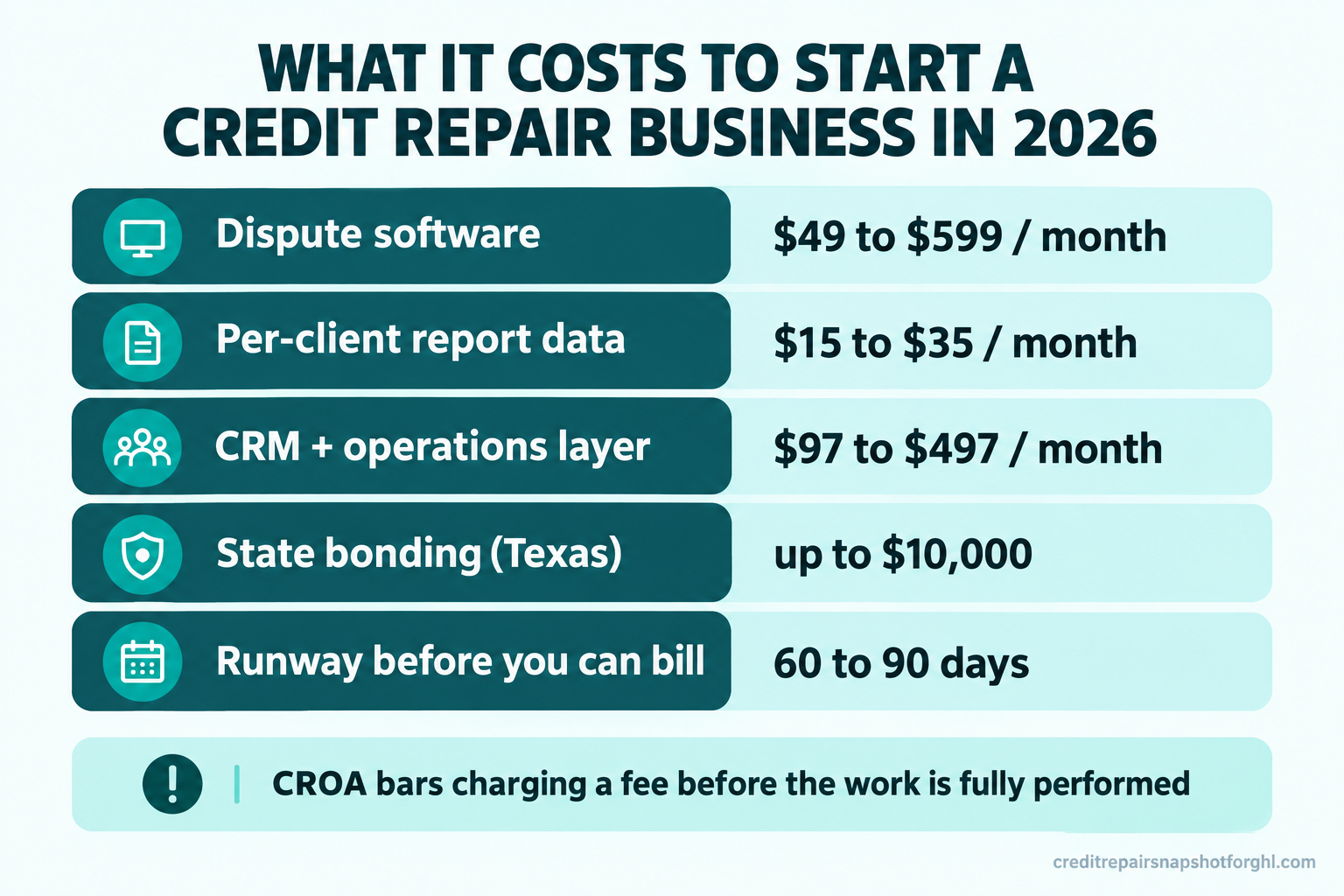
So here is the straight answer. The tools are cheap: you can be fully operational for roughly $250 to $400 a month in software. The expensive part is everything around them. Leads cost more than the software. Compliance can cost you a surety bond, or in one state your ability to operate at all. And because federal law bars you from charging before the work is done, you need cash to fund 60 to 90 days of operating before a single client payment clears. Budget for the runway, not just the subscriptions, and you will not fold in month four with a full client roster and an empty bank account.
Table of contents
- The cost nobody quotes you: the CROA runway
- What the software actually costs
- Line item 1: dispute software
- Line item 2: the data to read a file
- Line item 3: your CRM and operations layer
- Line item 4: compliance and bonding
- Line item 5: leads, the real monster
- Line item 6: the runway and your own time
- Three honest scenarios
- Steal this: a month-one budget
- The questions every new operator asks
- FAQ
The cost nobody quotes you: the CROA runway
The demand is not the problem. Credit or consumer reporting made up about 85% of the roughly 3.2 million complaints the CFPB received in 2024 (CFPB Consumer Response Annual Report), so there is no shortage of people who need help. The problem is getting paid for it. Every other business charges when it makes a sale. You do not. The Credit Repair Organizations Act (CROA) prohibits a credit repair organization from charging or receiving any money for its services before those services are fully performed (15 U.S.C. §1679b). The Federal Trade Commission enforces it, and “fully performed” does not mean “the client signed up.” It means the work you promised for that period is done.
In practice that creates a cash gap on day one. You sign a client, pull the file, start the work, and you cannot bill until that work is complete, usually at the end of the first service month. Multiply that by every client you add, and you are funding software, leads, and your own hours for weeks before any revenue arrives. The firms that fail rarely fail because the tools were too expensive. They fail because they counted on money CROA would not let them collect yet, and ran out of cash while the client list was still growing.
So the first number in your budget is not a subscription. It is runway. Decide how many months of costs you can cover with no revenue, because that number decides how many clients you can safely onboard at once. For the pricing mechanics that fit inside this rule, our credit repair pricing playbook and the recurring billing without chargebacks guide both build from the same constraint.
What the software actually costs
Here is the part people overestimate. The software to run a credit repair business is cheap. Below is what the main dispute platforms charge in 2026, from their current published plans.
| Tool | Entry price | Top tier | Free trial | Notes |
|---|---|---|---|---|
| Credit Repair Cloud | $49/mo (Personal) | $599/mo (Enterprise) | 30 days | Real client work starts at the $179 Start plan (source) |
| Client Dispute Manager | $99/mo (Beginners) | $199/mo (Established) | Yes | Three tiers, $99 to $199 (Capterra) |
| DisputeBee | $49/mo (Individual) | $129/mo (Business) | No | Business tier adds client management (review) |
| ScoreCEO | $149/mo (KickStart) | $299/mo (Advanced) | 7 days | Client and affiliate portals included (review) |
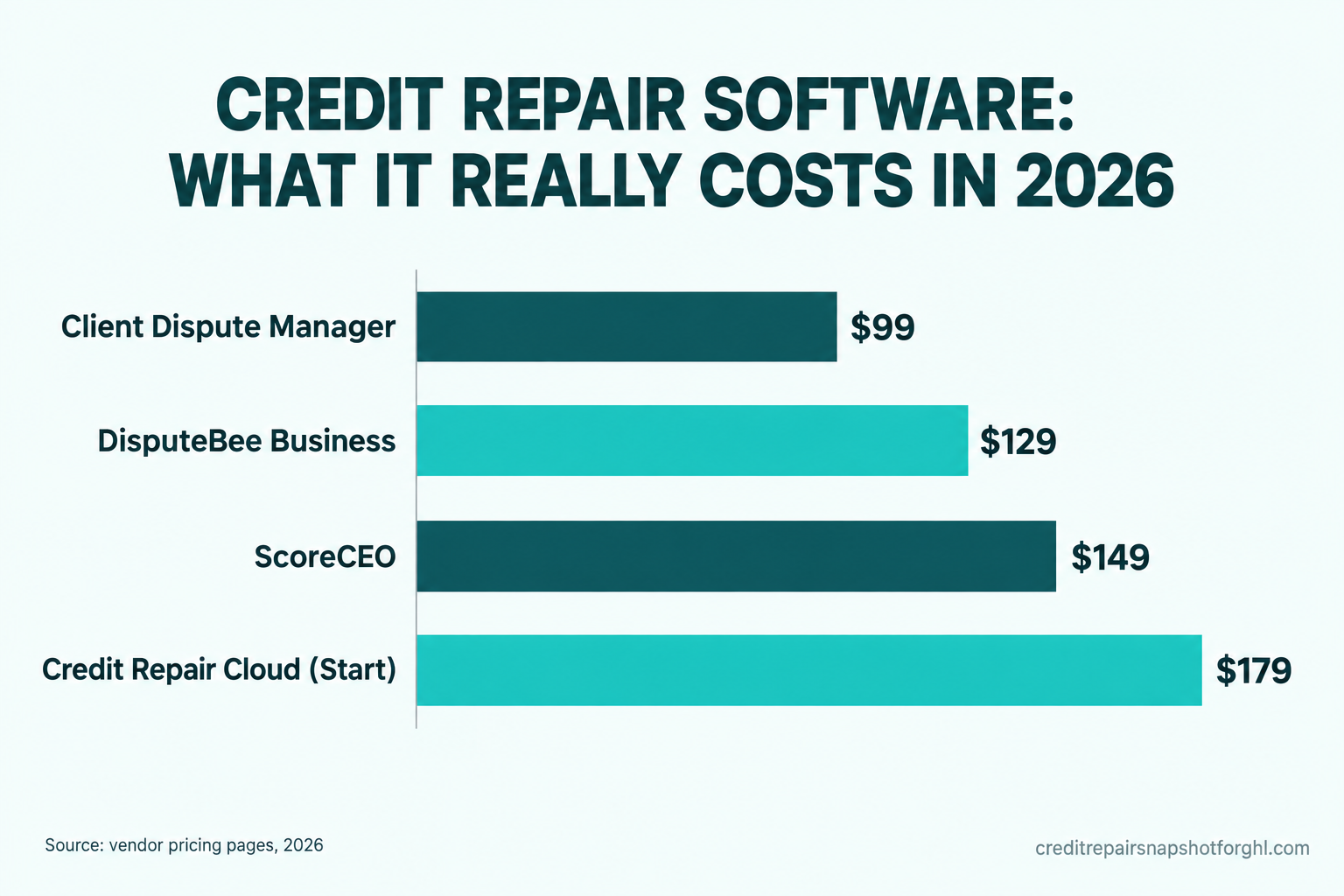
DisputeFox sits in this range but gates its full tiers behind a demo, so get your number in writing first. The honest read: a solo operator does not need the $399 tier of anything. DisputeBee Business at $129 or Client Dispute Manager at $99 covers real client work. For the deeper comparison, see the best credit repair software for a solo operator. Stack the categories together and a lean solo operation looks like this.
A lean solo software stack: roughly $311 a month before a single lead. Figures from vendor pricing pages (DisputeBee, GoHighLevel, IdentityIQ), 2026.
That is the whole software cost: around $300 a month. Everything after this is where the money goes.
Line item 1: dispute software
This is the tool that reads a client’s report, tracks what you are disputing, and generates the letters your firm reviews and sends. Budget $49 to $199 a month to start, and resist the upsell.
How it breaks. The most common and expensive mistake here is buying for the business you imagine instead of the one you have. A $399 tier that supports 1,200 active clients is waste when you have four. Start on the smallest plan that supports real client management (not a personal tier) and upgrade the day you need it. And pick one platform; paying for two tools that do the same job is money that should have gone to leads.
Line item 2: the data to read a file
You cannot dispute what you cannot see. Every active client needs a three-bureau report and monitoring feed so you can read the file and watch for changes. Consumer monitoring services are the usual source, priced per person per month.
IdentityIQ runs about $6.99 to $30 a month depending on tier (pricing), and MyScoreIQ, which many firms route clients to for three-bureau FICO data, runs $14.99 to $34.99 (plans). Call it $15 to $35 per client, per month as a planning number.
How it breaks. The clean way is for the client to hold their own monitoring subscription, give you access, and carry the cost. The sloppy way, which feels friendlier, is to front it for everyone. Do that across thirty clients and you have quietly added $600 to $1,000 a month to your overhead for a cost that was never yours. Decide your policy before client one and put it in the agreement.
Line item 3: your CRM and operations layer
Here is the line item most operators skip, and the one that decides whether you survive past fifty clients. Your dispute software tracks disputes. It does not answer your phone at 7pm, text a client who went quiet, send the signed agreement, hold billing until it is lawful to charge, chase a failed payment, or ask a happy client for a review. That is the operations layer, and without it you become the operations layer, which caps the business at what one tired person can hold in their head.
Most operators run this on GoHighLevel: $97 a month (Starter), $297 (Unlimited) once you add staff, $497 (SaaS Pro) for agencies reselling it. On top of the platform you still have to build the credit-repair workflows: CROA-safe onboarding, progress updates, billing logic, the review pipeline. Building those yourself is weeks of work and the most common place a launch stalls.
Disclosure: we are a GoHighLevel affiliate, so if you sign up through our link we may earn a commission at no additional cost to you.
How it breaks. Operators treat this as optional and run the business out of text threads, a spreadsheet, and memory. It works at ten clients and falls apart at fifty, which is exactly why we wrote why you cannot scale past 50 clients. The ops layer is not the thing you add once you are big. It is the thing that lets you get big.
Line item 4: compliance and bonding
Compliance has two kinds of cost: the kind that is free but constrains your cash, and the kind that is a real check you write. The free-but-constraining kind is CROA itself. The written contract, the Consumer Credit File Rights disclosure, the three-business-day cancellation right, and the advance-fee ban cost no money to follow. They cost you timing, which is the runway problem above. Our CROA-compliant onboarding checklist walks the whole sequence.
The write-a-check kind is state law, and it varies hard. Many states regulate credit repair under Credit Services Organization (CSO) statutes that add registration and bonding. Texas lets a CSO charge in advance only if it maintains a $10,000 surety bond or surety account per location and files a copy with the Secretary of State (Finance Code §393.401). You do not pay $10,000; you pay a bond premium, often a few hundred dollars a year, plus the filing. Georgia is in a category of its own: operating a credit repair services organization there is a misdemeanor under O.C.G.A. §16-9-59, with narrow exemptions only for 501(c)(3) nonprofits and licensed attorneys. If you are in Georgia, the startup-cost conversation ends before it begins.
Line item 5: leads, the real monster
This is the number that dwarfs everything else and the reason “the software is only $300 a month” is a half-truth. You can own the best stack in the niche and still starve with an empty pipeline.
Shared credit repair leads run roughly $3 to $25 each, exclusive leads $20 to $200 or more, and pre-qualified leads higher still (lead vendor pricing). Buy fifty exclusive leads at $40 and convert one in ten, and you have spent $2,000 to land five clients who cannot pay you for a month. That is the runway math made real.
There is also a hidden tax on your outreach. Credit repair is debt-relief-adjacent, which makes carriers nervous, so your A2P 10DLC texting registration is routinely scrutinized and sometimes rejected for this exact niche. A rejection mid-launch means your reminders and follow-ups silently fail to send. We wrote the article nobody else does on this in getting your credit repair texts approved at A2P 10DLC. It belongs in your launch checklist, not your month-six cleanup.
Line item 6: the runway and your own time
The last cost is the one with no invoice: you. For the first few months you are the salesperson, dispute analyst, bookkeeper, and support line, while federal law holds the revenue door shut for the first month of every client. Put a number on it. If you need $4,000 a month to live and you are full time, that is $12,000 across a 90-day ramp, as much a startup cost as any subscription. Underfund it and you take on too many clients too fast, which drops service quality right when your reputation is being formed.
Three honest scenarios
The same business costs wildly different amounts by stage. Here is the cash you should have on hand to survive the ramp at three sizes. These are planning estimates, not a quote, and they assume clients carry their own monitoring.
Illustrative 90-day cash-on-hand needed to launch at each stage, including software, leads, and your own time. A model, not a guarantee.
Solo operator (1 to 25 clients). Software around $300 a month, leads $500 to $1,500, your own time on top. Realistic cash to launch cleanly: $3,000 to $6,000, almost none of it software.
Small team (3 to 5 people). GoHighLevel Unlimited at $297, a bigger dispute tier, real ad spend. Tools climb to $600 to $900, leads to $3,000 to $6,000, plus payroll. Cash to run the ramp: $12,000 to $25,000.
Established shop (300+ clients). Software is a rounding error against payroll and ad spend, often $30,000 to $60,000 a month, and runway becomes a working-capital question. Cash buffer: $40,000+.
Across all three, software barely moves as a share of the bill. The cost of this business is cash flow, leads, and labor. Pick your tools for fit and move on.
Steal this: a month-one budget
Open a sheet, put these exact lines in it, and fill the ranges with the real quotes you gathered. That is a defensible launch budget instead of a guess.
The two ways operators run the stack
Dispute tool + spreadsheet + text threads + manual invoicing. Cheap on paper, caps you at the clients one person can track, leaks revenue every time a payment fails quietly.
Dispute tool + one operations layer that onboards, updates, bills, and recovers on autopilot. Costs a little more monthly, removes the ceiling that ends most solo firms at fifty clients.
The questions every new operator asks
Can I just start with the cheapest tool and skip the CRM?
For your first handful of clients, yes, and plenty of people do. The honest warning is that the manual approach is not a cost you avoid, it is a cost you defer. Every hour spent copying statuses between a dispute tool and a spreadsheet is an hour you did not spend selling, and the day a payment fails quietly, you lose MRR that would have paid for the ops layer. Skip it early, add it before fifty clients.
Do I really need to fund 90 days of runway?
You need to fund the gap between signing clients and legally billing them, times the rate you add clients. Onboard slowly and the gap is small; 60 days may be plenty. Onboard twenty in month one and you have twenty clients you cannot bill for a month plus a lead bill already due. The faster you grow, the more runway you need, not less.
I already pay for Credit Repair Cloud. Do I need anything else?
Credit Repair Cloud handles the disputes. It does not handle the operations around them: the signed agreement, the progress updates that keep clients from going silent, compliant billing, dunning when a card fails, and the review engine. Those live in your CRM layer, a separate line item. You are not replacing your dispute software; you are adding the layer it was never built to be.
FAQ
How much does it cost to start a credit repair business in 2026?
The software is cheap, roughly $250 to $400 a month for a dispute tool, a CRM, and credit data. The larger costs are leads, any state bonding, and the 60 to 90 days of runway you must fund because CROA bars charging before the work is done. A lean solo launch realistically needs $3,000 to $6,000 of cash on hand.
Why can't I charge clients upfront?
The federal Credit Repair Organizations Act (CROA) prohibits charging or receiving any fee before the promised services are fully performed (15 U.S.C. §1679b), and the FTC enforces it. You bill after the first service period, not at signup, which creates the cash gap new operators underestimate.
What is the cheapest credit repair software?
Among business-grade tools in 2026, DisputeBee Business at $129 a month and Client Dispute Manager at $99 a month are the lowest real entry points. Credit Repair Cloud has a $49 Personal tier, but it is friends-and-family only, with real client work starting at $179. Confirm each price on the vendor's own page.
Do I need a license or bond to do credit repair?
It depends on your state. Many states regulate credit repair under Credit Services Organization laws requiring registration and a surety bond; Texas requires a $10,000 bond to charge in advance. Georgia makes operating a credit repair services organization a misdemeanor outright. Verify your state with the Secretary of State or a licensed attorney first.
How much do credit repair leads cost?
Shared leads run roughly $3 to $25 each and exclusive leads $20 to $200 or more. Because conversion on cold leads is low, your real cost per signed client can run into the hundreds, and you cannot bill that client for a month, so lead spend is the biggest driver of how much runway you need.
Back to that Tuesday morning and your first three clients. The signatures were the easy part. The business you are starting is a cash-flow business wearing a compliance jacket, and the operators who make it funded the gap, chose boring affordable tools, respected their state’s rules, and built the operations layer before they needed it. The software was never going to sink you. Running out of runway while the client list grew was. Budget for the part nobody quotes you, and the rest is just work.