

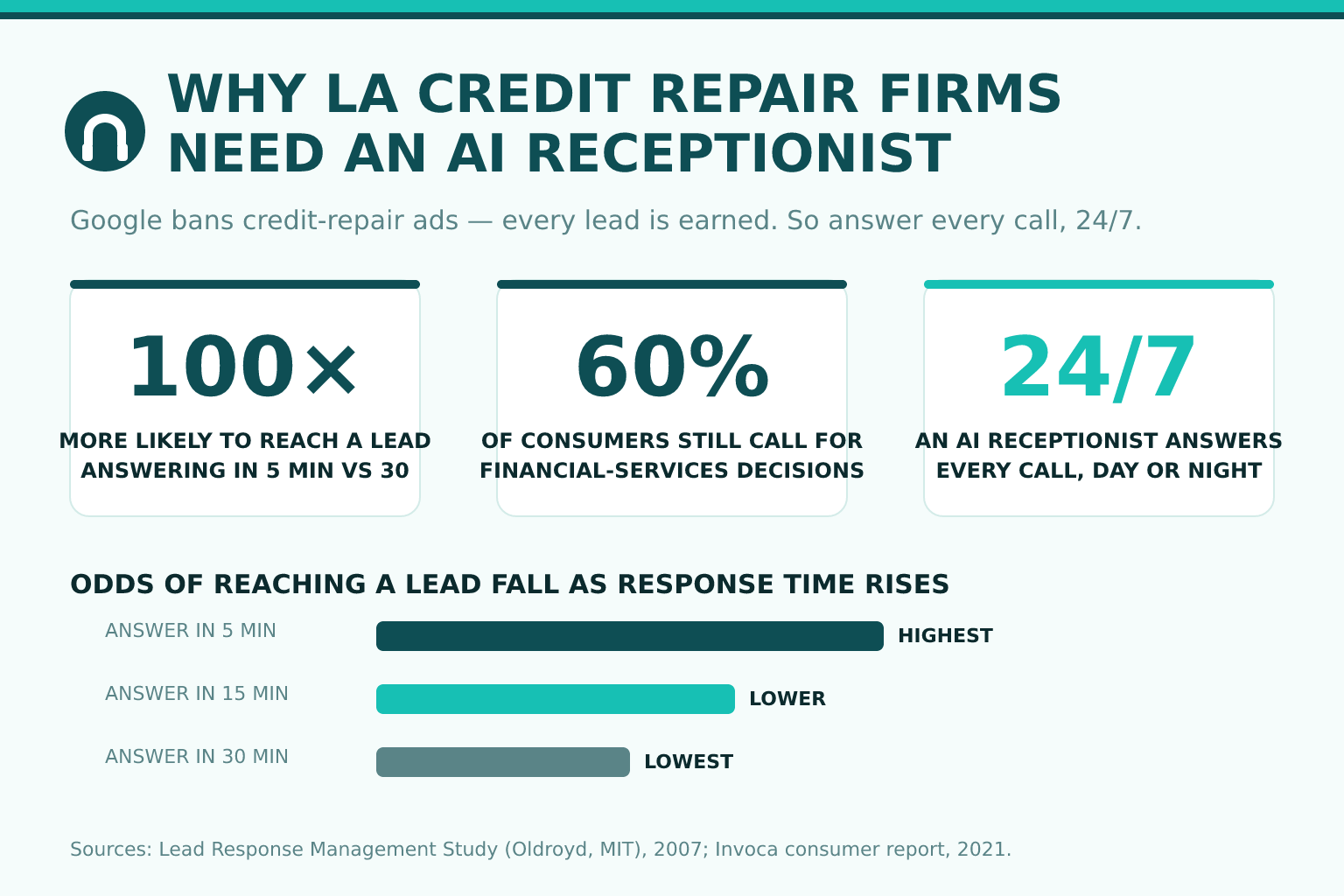
For a Los Angeles credit repair firm, the most expensive thing you can do all day is let a call ring out. Someone just got denied on a mortgage in Inglewood or had their report pulled for an apartment in Koreatown, they searched “credit repair near me,” and they’re dialing the first firm that looks legitimate. If you’re on another call, in a consultation, or asleep — and the call hits voicemail — they don’t leave a message. They dial the next firm. An AI receptionist that answers every call 24/7, qualifies the caller, and books the consultation is the single highest-leverage system a small LA firm can add, because in this niche you can’t buy the lead back.
Here’s the uncomfortable structural fact underneath it: Google prohibits credit-repair ads entirely (Google Ads policy). You can’t retarget the person who bounced. Every prospect who reaches you came through organic search, the map pack, a referral, or your reputation — channels you spent months earning. Losing one to a missed call isn’t a small leak; it’s throwing away the most expensive thing you own. This post is the operator’s case for fixing it, built on real speed-to-lead data — not hype. We sell the operating system, never the outcome: an AI receptionist books consults; it never promises a deletion or a score change.
Table of contents
- Why every LA credit repair lead is expensive
- The 5-minute window: what the speed-to-lead data proves
- Most firms are slow — which is exactly your opening
- Why the phone specifically matters in credit repair
- The Los Angeles math: how big the missed-call problem is
- What an AI receptionist actually does (and never does)
- Voicemail-and-callback vs an AI receptionist
- How to deploy it in LA without overpromising
- Frequently asked questions
- About the author
- Sources
Why every LA credit repair lead is expensive
Start with the channel math, because it’s what makes this niche different from a plumber or a dentist. Most local businesses can paper over a slow response with paid ads — miss a call, and a Google or Meta ad brings the prospect back tomorrow. Credit repair firms can’t. Google’s financial-services advertising policy prohibits ads for credit-repair services outright (Google Ads policy; see also WordStream’s summary of the 2019 change).
That single restriction reshapes the entire economics of an LA firm:
- Every lead is earned, not bought. Your prospects arrive through organic search, the Google map pack, referrals from loan officers and realtors, and your review reputation. Each one cost you real time and money to produce.
- There’s no retargeting safety net. When a bought-traffic business loses a lead, an ad re-engages it. When you lose one, it’s gone to whichever competitor picked up the phone.
- The searcher is in a hurry and in a bad mood. A denied loan or a pulled report is an emotional, urgent moment. That person is calling three firms in ten minutes and going with whoever answers first and sounds trustworthy.
So the question isn’t “should we spend more on marketing.” It’s “are we actually catching the expensive traffic we already earn?” For most small firms, the honest answer is no — because a human front desk can’t cover 24/7, and the calls that leak most are exactly the after-hours, weekend, and mid-consultation ones. (For the front-half of this system — how fast leads arrive and get worked — see our AI lead generation playbook for credit repair and the Miami page-speed breakdown on why earned traffic is too costly to waste.)
The 5-minute window: what the speed-to-lead data proves
Speed-to-lead is the most-replicated finding in inbound sales, and it is brutal. The foundational Lead Response Management study — analyzed by Dr. James Oldroyd (then at MIT Sloan) across thousands of leads — found that the odds of a successful contact collapse minute by minute. Reach out within 5 minutes instead of 30, and you are roughly 100× more likely to make contact and 21× more likely to qualify the lead (Lead Response Management / MIT, 2007).
Later industry analysis pointed the same direction: Velocify’s review of millions of leads found that calling a brand-new lead within the first minute lifted conversion dramatically (Velocify, “The Ultimate Contact Strategy”). The exact multiplier varies by dataset, but the shape never does — response speed, not effort or spend, is the dominant lever on whether an earned lead becomes a client.
For an LA credit repair firm this is decisive, because the moment a prospect is most likely to convert is the moment your team is least likely to be free: a Sunday night after the denial email lands, a Tuesday afternoon while you’re deep in a consultation. A voice agent that picks up on the first ring, every hour of every day, is the only way to actually be inside that 5-minute window consistently. This is the same speed principle behind reducing lost bookings — see how to cut no-shows with consultation booking.
Most firms are slow — which is exactly your opening
The flip side of speed-to-lead is the reason it’s such a cheap edge: almost nobody actually does it. When Harvard Business Review audited how 2,241 U.S. companies responded to a fresh online lead, the results were dismal — and they’re your competitive opening in Los Angeles.
Read that chart as a market map, not a scold. Only about 1 in 3 firms replies within the hour, and roughly 1 in 4 never replies at all (HBR, 2011). In a crowded LA market shadowed by scam operators, “we answer instantly, 24/7, and treat you seriously” is a genuine differentiator — and it’s one you can automate rather than staff. The firms losing to you won’t be the ones with the best offer; they’ll be the ones that answered second.
Why the phone specifically matters in credit repair
You might reasonably ask: if we’re fast on web forms and chat, do we still need the phone covered? For this niche, yes — because credit repair is a high-stakes, emotional, high-consideration decision, and that’s precisely the category where people still pick up the phone.
Invoca’s consumer research found that 60% of consumers still call a business when the decision involves financial services, and 87% say they feel more confident making a high-consideration purchase over the phone than through a website (Invoca, 2021). A person about to hand a firm their Social Security number and their credit history wants to hear a human-sounding voice take them seriously before they commit.
Calls are also higher-intent than form fills. BIA/Kelsey’s long-cited analysis found inbound phone calls convert to meaningfully more revenue than web leads, because a caller has already decided to act (BIA/Kelsey, via industry reporting). Put those two facts together and the conclusion is sharp: the phone is where your best LA leads are, and it’s the channel a small firm is worst at covering. An AI receptionist closes exactly that gap.
Most “lost” credit repair clients were never really lost — they were unanswered. Someone called in a panic at 8 p.m., got a beep, and hung up. The firm never even knew they existed. Answering the phone, every time, is the cheapest client-experience upgrade there is.
The Los Angeles math: how big the missed-call problem is
Los Angeles is one of the largest addressable credit repair markets in the country, which means the cost of missed calls compounds fast. The LA–Long Beach–Anaheim metro is home to roughly 13 million people (U.S. Census), and nationally about 29.6% of consumers carry a subprime score under 670 — down from 34% in 2020, but still nearly one in three (Experian, 2025). Applied to a metro that size, the pool of people who could use credit help is measured in the millions.
Demand shows up in the complaint data, too. In 2024 the CFPB logged about 3.19 million consumer complaints, and more than 85% of them concerned credit or consumer reporting (CFPB, 2024). The underlying driver is error: the FTC’s landmark accuracy study found that 1 in 5 consumers had an error corrected on at least one credit report, 26% found a potential error, and 5% had errors serious enough to raise the cost of a loan or insurance (FTC, 2012).
The takeaway isn’t “the market is huge, so relax.” It’s the opposite: with demand this large and every lead un-buyable, the constraint on an LA firm’s growth usually isn’t marketing spend — it’s capture. You are already earning more calls than you catch. The cheapest growth available is answering the phone you’re already paying to make ring. For the full national picture, see our 2026 credit repair industry statistics.
What an AI receptionist actually does (and never does)
“AI receptionist” can sound like hand-wavy AI jargon, so let’s be concrete. For a credit repair firm, a well-built voice agent does five specific jobs — and deliberately refuses a sixth.
- Answers instantly, 24/7. It picks up on the first ring under your firm’s name — after hours, on weekends, and while your team is mid-consultation. No voicemail, no callback that never comes.
- Qualifies the caller. It gathers the basics — what happened, what they’re trying to qualify for (mortgage, auto, rental, a card), and how to reach them — in a calm, on-brand voice.
- Books the consultation. It reads live availability from your calendar, offers real time slots, and confirms the booking by SMS and email — turning a 9 p.m. panic call into a Monday consult already on the books.
- Logs everything. The call summary and contact details land on the client record in your CRM, searchable and ready for a human to follow up.
- Routes anything that needs judgment. A complex situation or a real strategy question is flagged and handed to a specialist on your team.
And the line it does not cross: it does not give credit or legal advice, quote timelines, estimate results, or promise that any item will be removed or any score will improve. Those are reserved for your team, which is what keeps the firm on the right side of CROA. The AI’s lane is answer, qualify, book, log, route — nothing that constitutes advice or an outcome promise. (In the Credit Repair Snapshot, this is the AI Caller feature; pair it with the AI chatbot to cover web and social the same way.)
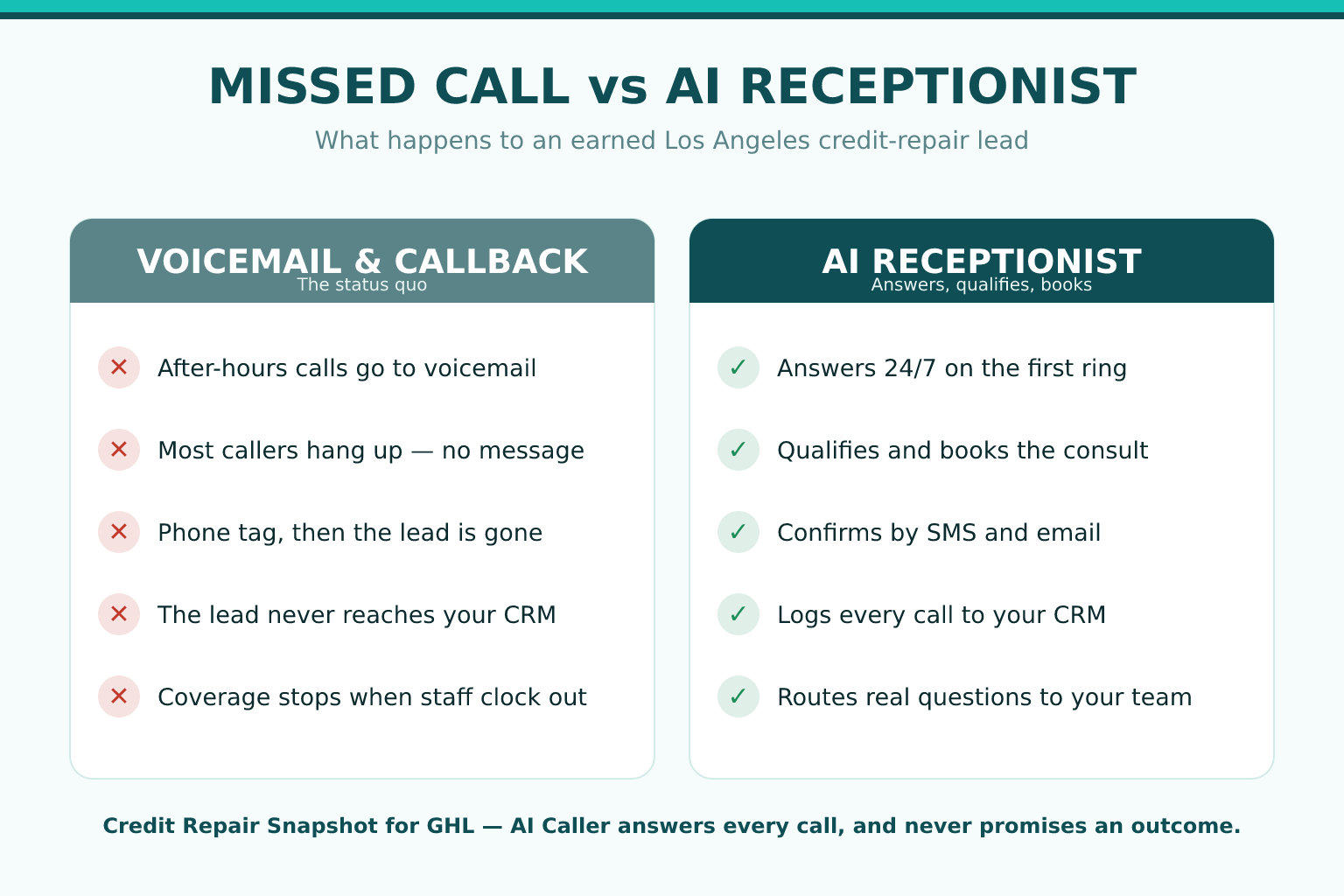
Voicemail-and-callback vs an AI receptionist
Here’s the honest side-by-side for a small LA firm choosing between the status quo (voicemail plus a callback queue, maybe a part-time front desk) and an always-on AI receptionist.
| Factor | Voicemail + callback / part-time front desk | AI receptionist (24/7 voice agent) |
|---|---|---|
| After-hours & weekend calls | Go to voicemail; most callers hang up | Answered on the first ring, every time |
| Speed to first contact | Minutes to hours (often next business day) | Instant — inside the 5-minute window |
| Mid-consultation overflow | Missed while you’re with a client | Picked up in parallel, no conflict |
| Cost | A receptionist’s salary can’t cover 24/7 | Flat monthly cost, covers all hours |
| Consistency & tone | Varies by who answers and their mood | Same calm, on-brand, compliant script every call |
| Booking | Manual callback, phone tag, drop-off | Books straight to your calendar with confirmations |
| CRM record | Often none — the lead is invisible | Full transcript and contact logged automatically |
| Compliance lane | Depends on staff training | Scripted to never give advice or promise outcomes |
The point isn’t that humans are bad at this — it’s that no small team can physically be available in the 5-minute window at 9 p.m. on a Sunday. The AI receptionist doesn’t replace your specialists; it makes sure they walk into booked consultations instead of a list of missed calls.
How to deploy it in LA without overpromising
If you’re adding an AI receptionist, treat it as an operations project, not a magic button. This is the sequence that gets it live safely:
- Route your main line through it. Point your existing business number so the voice agent answers when your team can’t — after hours by default, and as overflow during the day.
- Script the lane, in writing. Give it your firm’s name, the qualifying questions, and an explicit list of things it must never say (no timelines, no deletion promises, no advice). Route anything substantive to a human.
- Wire it to your calendar and CRM. Live availability in, confirmed bookings and full call logs out. If the lead isn’t captured in your CRM, the system failed.
- Localize for Los Angeles. Have it recognize the neighborhoods and nearby cities you serve, and mirror the language your LA prospects actually use — so the intake feels local, not generic.
- Review transcripts weekly. Read what callers ask and how the agent handled it. Tighten the script, fix any mis-routes, and confirm it’s staying inside the compliance lane.
- Measure capture, not vanity. Track calls answered, consults booked, and show rate — the numbers that tie directly to revenue.
You can build this yourself inside GoHighLevel, or get the AI Caller preconfigured in the Credit Repair Snapshot — one $997 system that also handles CROA-compliant onboarding, dispute-round progress updates, recurring billing, and review harvesting. Either way, the standard is the same: answer every call, book the consult, log everything, and never promise an outcome. In a market this large where every lead is earned, catching the phone is the cheapest growth you’ll ever buy.
Frequently asked questions
What is an AI receptionist for a credit repair firm?
It's an AI voice agent that answers your inbound calls 24/7, greets the caller under your firm's name, qualifies them (what happened, what they want to qualify for, how to reach them), books a free consultation onto your calendar, and logs the full conversation to your CRM. It handles answering, intake, and scheduling — not advice. Anything substantive is routed to a human on your team, which keeps the firm inside CROA guardrails.
Why can't a Los Angeles credit repair firm just run ads to replace missed calls?
Because Google's financial-services advertising policy prohibits credit-repair ads outright, so you can't retarget or re-buy a prospect who bounced. Every LA lead is earned through organic search, the map pack, referrals, and reputation — which makes each missed call pure waste. Fixing capture (answering the phone) is far cheaper than trying to generate replacement demand.
Does responding fast really matter that much?
Yes — it's one of the most-replicated findings in inbound sales. The MIT-analyzed Lead Response Management study found that contacting a new lead within 5 minutes versus 30 makes you about 100x more likely to reach them and 21x more likely to qualify them. And Harvard Business Review found only 37% of 2,241 audited companies replied within an hour, with 23% never responding — so simply answering instantly puts you ahead of most competitors.
Will an AI receptionist create CROA compliance risk?
Not if it's scoped correctly. Configure it to answer, qualify, and book only — and to never quote a timeline, estimate results, promise a deletion or score increase, or give credit or legal advice. Every substantive question routes to a human. Your firm remains the credit repair organization responsible for CROA compliance; the AI is an intake and scheduling tool, not a counselor. Reviewing transcripts weekly keeps it in its lane.
How is an AI receptionist different from just adding voicemail or a call service?
Voicemail loses the caller — most people who reach a beep hang up and dial the next firm, and you never even know they called. A part-time front desk can't cover nights, weekends, or mid-consultation overflow, which is exactly when high-intent credit repair calls come in. An AI receptionist answers all of those instantly, books the consult, and logs the lead to your CRM at a flat monthly cost, so no earned call goes uncaptured.
Do people actually want to talk to an AI instead of a person?
They want to be answered and taken seriously, immediately. Invoca found 60% of consumers still call for financial-services decisions and 87% feel more confident on the phone for high-consideration purchases. A calm, on-brand voice agent that picks up on the first ring, listens, and books them a consult beats a voicemail every time — and complex questions still route to your human specialists.
About the author
Simran Kaur is a Client-Experience & Review-Pipeline Designer focused on credit repair. She came up through customer success at a fintech startup and now helps firms and their GHL partners design lifecycle communication — from first-call intake to five-star review pipelines — that feels personal at scale. Her favorite metric is reply rate, and she believes most cancellations are really just unanswered questions. Simran is a fictional editorial persona used for authorship attribution; her articles are operational guidance, not legal or financial advice.
Related reading
- AI Lead Generation for Credit Repair: The 2026 Playbook
- Credit Repair Industry Statistics 2026: Market Size, Demand & Benchmarks
- How to Reduce No-Shows on Credit Repair Consultations
- Astro vs GoHighLevel Websites for Miami Credit Repair Firms: Page Speed Compared
Sources
- Google Ads — Financial products and services policy — credit-repair advertising is prohibited. Secondary: WordStream (2019).
- Lead Response Management Study (Oldroyd, MIT / InsideSales, 2007) — 5-min vs 30-min response: ~100× contact, ~21× qualify; Velocify contact-strategy data.
- Harvard Business Review — “The Short Life of Online Sales Leads” (2011) — audit of 2,241 U.S. companies: 37% replied within 1 hour, 23% never responded.
- Invoca — “Buy It Yourself” consumer report (2021) — 60% call for financial services; 87% more confident on the phone for high-consideration purchases; BIA/Kelsey call-conversion context.
- CFPB — Consumer Response Annual Report 2024 (PDF) — ~3.19M complaints; 85%+ credit/consumer reporting.
- FTC — Credit Report Accuracy Study (2012) — 1 in 5 had a corrected error; 26% a potential error; 5% material cost impact.
- Experian — Subprime study (2025) — ~29.6% of consumers subprime (score under 670), down from 34% in 2020.
- U.S. Census Bureau — QuickFacts, California — LA–Long Beach–Anaheim metro ≈ 13M residents.
Credit Repair Snapshot for GHL is a GoHighLevel automation product. We are not a credit repair organization, law firm, or credit bureau, and we do not dispute items, repair credit, or provide credit, legal, or financial advice. You remain responsible for CROA and TCPA compliance. Results vary; we make no promise that any item will be removed or that any score will improve.