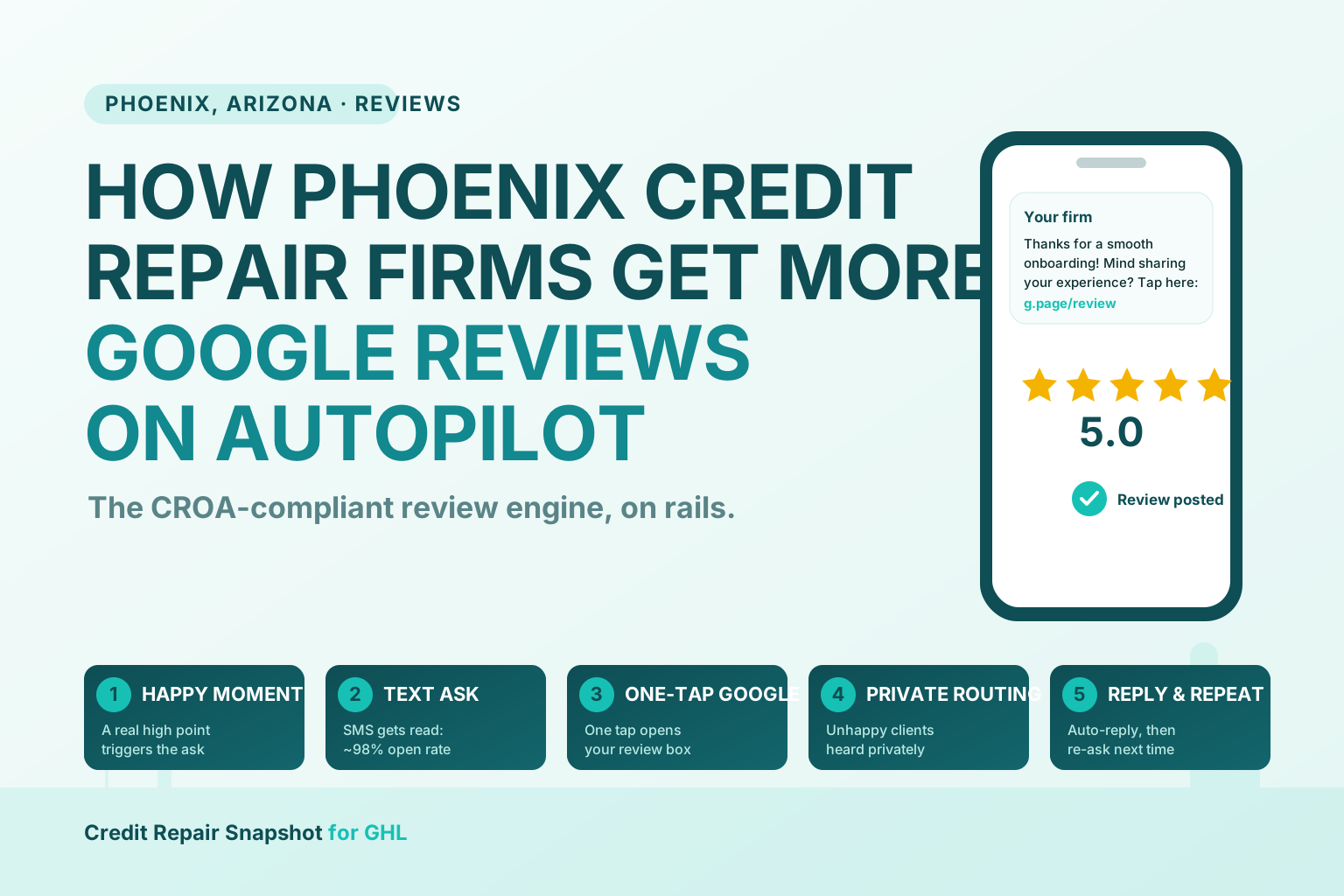
For a Phoenix credit repair firm, the review count on your Google Business Profile is doing more selling than your website ever will. Someone in Ahwatukee just got denied on a mortgage, searches “credit repair near me,” and the map pack shows three firms side by side. They don’t read your service page — they scan the star ratings and the number in parentheses, and they tap the firm that looks like other people already trusted it. The fastest way to lose that person is to have four reviews from 2022 while the firm below you has sixty recent ones.
The good news: getting more honest Google reviews is not a hustle problem, it’s a systems problem. Firms that win on reviews aren’t asking harder — they’re asking every satisfied client, at the right moment, automatically, and doing it inside CROA guardrails so the review pipeline never becomes a liability. This is the exact playbook for building that system in GoHighLevel.
Table of contents
- Why Google reviews decide the Phoenix credit repair race
- Set the compliance guardrails before you automate anything
- The 5-step autopilot review system (build it in GoHighLevel)
- Why the ask goes out by text, not email
- Route unhappy clients to private feedback — compliantly
- Respond to every review (and keep them recent)
- What “good” looks like for a Phoenix firm
- Frequently asked questions
- About the author
- Sources
Why Google reviews decide the Phoenix credit repair race
Phoenix is one of the fastest-growing metros in the country, which means two things for a local credit repair firm: a large, steady stream of people who need help, and a crowded map pack of firms competing to be the one they call. In this niche the competition is decided disproportionately by reviews, for three reasons.
First, trust is the entire product. A prospect is handing you sensitive financial details and a monthly payment, in a niche shadowed by scam operators. The single biggest thing that makes that leap feel safe is watching strangers go first. Recent, specific, five-star reviews are the proof.
Second, you can’t buy your way to the top. Google’s advertising policy bans credit repair ads from serving, so you can’t offset a thin profile with paid traffic. Almost every prospect arrives through organic search, the local map pack, or a referral — and in the map pack, reviews are one of the levers that decide who ranks and who gets tapped. (For the full local search picture, see our credit repair SEO playbook.)
Third, the demand is real and large. In 2024 the CFPB logged more than 2.8 million consumer complaints, and about 85% of them were about credit or consumer reporting (CFPB, 2024). The FTC’s landmark accuracy study found 1 in 5 consumers had a confirmed error on at least one of their three credit reports, and 5% had errors serious enough to raise their cost of borrowing (FTC, 2013). People across the Valley are actively looking for a firm to help — the only question is whether yours looks trustworthy enough to be chosen.
Share of consumers with credit-report errors (%), from the FTC’s congressionally mandated Study of Credit Report Accuracy (2013). “1 in 5” is shown as 20%. This is demand context for the niche, not a promise of any outcome.
And reviews don’t only build trust — they move revenue. In the most-cited academic study on the topic, a one-star increase in a business’s online rating was associated with a 5–9% increase in revenue (Harvard Business School, Luca 2016). BrightLocal’s ongoing research consistently finds that the vast majority of consumers — around 98% — use the internet to find information about local businesses, with reviews a central part of that process (BrightLocal).
Set the compliance guardrails before you automate anything
Before a single automation goes live, the rules. In this niche, a sloppy review program isn’t just ineffective — it’s a compliance exposure. Three bright lines, non-negotiable:
- No implied results in the ask. A review request must never say or imply “leave us a review for getting your score up” or “for deleting your collection.” Your firm sells process and effort, not outcomes. The ask celebrates the experience — clear communication, responsiveness, being kept informed — not a credit result.
- Don’t illegally gate reviews. Routing an unhappy client to a private conversation before they hit a public review is fine and smart. Blocking, filtering, or suppressing honest negative reviews from ever reaching the public — “review gating” — violates platform policy. The line is: you may ask everyone privately how it went and make the happy path to Google effortless, but you never prevent a determined client from posting.
- Stay inside CROA everywhere. The review pipeline is marketing that touches enrolled clients, so it inherits every CROA obligation your other communications carry. Nothing about it can promise a deletion or a score change.
Get these right once at the template level and every downstream automation stays clean. For the deeper mechanics of a compliant pipeline, see our five-star review pipeline for credit repair firms.
The 5-step autopilot review system (build it in GoHighLevel)
Here is the system that turns satisfied Phoenix clients into a steady stream of Google reviews without you remembering to ask. Each step is a workflow you build once inside GoHighLevel; after that it runs on every client, forever.
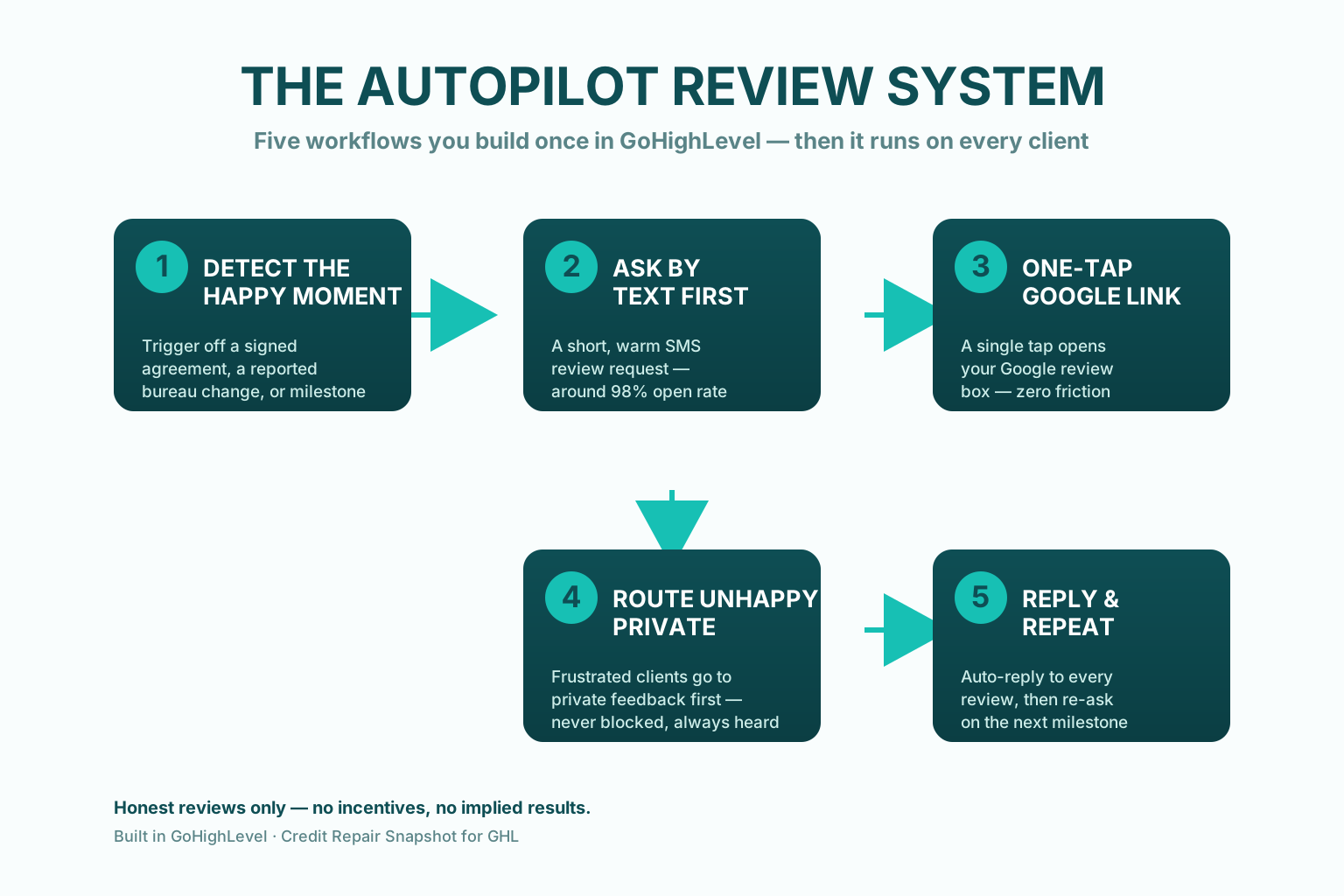
Step 1 — Detect the happy moment (trigger, not calendar). The worst time to ask for a review is a random Tuesday. The best time is right after a genuine high point. Wire the ask to fire off a real event in the CRM: a client e-signs their agreement and finishes a smooth onboarding, a monitored bureau change gets reported to them, or they hit a program milestone. These are the moments trust is highest — and, critically, the ask stays about the service experience, not a promised result.
Step 2 — Send the ask by text first. The request goes out as a short, warm SMS (with a compliant, opted-in number), because that’s where it actually gets read (more on the numbers below). Keep it human: thank them, name the specific moment, and ask if they’d share their experience. One message, one link, no friction.
Step 3 — Give them a one-tap Google link. Every extra step loses reviews. Use your Google Business Profile “leave a review” short link so a single tap opens the review box, already on your profile, star selector ready. Pre-fill nothing about the content — just remove the navigation.
Step 4 — Branch on sentiment before the public ask. If you first ask “how was your experience?” and a client signals frustration, that client is routed into a private feedback flow and a task lands on your team to make it right — before they’re pointed to Google. Happy clients continue straight to the public review link. This is the compliant “make the happy path easy” pattern, not illegal gating (see the dedicated section below).
Step 5 — Reply, monitor, and re-ask. Every new review triggers an internal notification and a drafted, on-brand reply so no review sits unanswered. A light, spaced follow-up re-asks the non-responders once — never nagging — and the whole loop repeats on the next milestone. The result is velocity: a continuous trickle of recent reviews instead of a one-time push that goes stale.
Why the ask goes out by text, not email
The entire system depends on the request being seen. This is where the channel choice does the heavy lifting. According to Gartner, text messages see roughly a 98% open rate and a 45% response rate, compared with about 20% open and 6% response for email (Gartner). An email-only review request is a request most clients never open.
Open and response rates (%) for SMS vs. email, as reported by Gartner Digital Markets. SMS “open” is inferred from delivery and response data rather than directly measured.
Text-first doesn’t mean text-only. The pattern that works: SMS as the primary ask because it gets read, with email as a backup for anyone who doesn’t respond and for clients who prefer it. Every message must respect TCPA — the client opted in, the number is compliant, and STOP works. For the full compliant SMS setup (A2P 10DLC registration and consent), see our SMS marketing playbook for credit repair.
Route unhappy clients to private feedback — compliantly
This is the step most firms get wrong in both directions — some skip it and let a bad day become a public one-star, others cross the line into illegal gating. The compliant version is simple and powerful.
Ask a low-stakes question first: “Quick one — how’s your experience with us been so far?” Clients who respond positively get the one-tap Google link. Clients who signal a problem get a short, genuine “we want to fix that” message and a task routes to a human on your team, fast. You’ve caught a fixable issue before it became a public rating, and you’ve given yourself a chance to turn a frustrated client into a saved one.
The bright line: you may make the happy path to Google effortless and you may hear people out privately first, but you can never block, suppress, or filter a client who still wants to post an honest negative review. Interfering with honest reviews violates Google’s policy and FTC guidance. Done right, this step isn’t about hiding criticism — it’s about hearing it in time to act on it, which is exactly the retention behavior that keeps clients paying. (Closing that loop is the same instinct behind our win-back playbook for cancelled clients.)
Respond to every review (and keep them recent)
Getting the review is half the job. Two habits turn a pile of reviews into a ranking-and-conversion asset:
- Reply to all of them. A short, personal, on-brand reply to every review — positive and negative — signals to prospects (and to Google) that a real, attentive firm is behind the profile. Automate the notification and draft the reply so nothing sits unanswered for days. On negative reviews, respond calmly and factually, never disclose client details, and never argue about outcomes.
- Protect recency. A prospect trusts a profile with fresh reviews far more than one whose last review is eighteen months old, and recency is part of how the profile performs locally. Because the system is event-triggered, it produces a steady drip of new reviews month after month — which is precisely what keeps the profile looking alive and current for the next Phoenix searcher.
Most firms think they have a review problem. They actually have an asking problem — they ask rarely, randomly, and by email. Fix the timing, the channel, and the consistency, and the reviews were always going to be there.
What “good” looks like for a Phoenix firm
You don’t need a viral moment. You need a boring, reliable machine. A healthy Phoenix credit repair profile looks like this:
- Every satisfied client is asked — automatically, at their high point, not when someone on the team remembers.
- New reviews arrive steadily — a natural, sustained trickle rather than a single burst followed by silence.
- Every review has a reply — usually within a day, always on-brand, never disclosing client specifics.
- Unhappy clients are heard privately first — and a real person follows up before it becomes public.
- Nothing is incentivized and nothing implies a result — the profile is bulletproof as well as busy.
Build that once and reviews stop being the thing you feel guilty about not doing and become the channel quietly feeding you the next client. It’s the same operating philosophy behind the entire snapshot: put the repeatable work on rails so the firm can focus on the actual credit work. For the market context behind all of this, see our 2026 credit repair industry statistics.
Prefer to see just this piece first? Here’s the review harvesting automation feature on its own.
Frequently asked questions
Google reviews for Phoenix credit repair firms — FAQ
Is it legal to ask credit repair clients for Google reviews?
Yes — asking satisfied clients for an honest review is allowed and encouraged. What's not allowed is paying for or incentivizing reviews, writing fake ones, implying a guaranteed credit result in the ask, or blocking honest negative reviews from being posted. Keep the ask about the service experience, never about a score or deletion, and you're on solid ground.
Can I offer a discount to clients who leave a review?
No. Offering discounts, credits, gift cards, or any consideration in exchange for a review violates Google's policies and FTC endorsement guidance and can be treated as a deceptive practice. The system asks for honest feedback with no incentive attached — you're optimizing timing and ease, never the verdict.
Is routing unhappy clients to private feedback the same as illegal review gating?
No, as long as you never block a determined client from posting. Asking 'how was your experience?' first, making the Google link effortless for happy clients, and routing unhappy ones to a private conversation is compliant. It becomes illegal gating only if you suppress, filter, or prevent honest negative reviews from reaching the public.
How many Google reviews does a credit repair firm need?
There's no magic number, and it varies by market. What matters more is recency and velocity — a steady stream of recent, genuine reviews with owner replies signals an active, trustworthy firm to both prospects and Google, which a large pile of old reviews does not. Aim for a reliable drip, not a one-time push.
Why send the review request by text instead of email?
Because it gets read. Gartner reports SMS sees roughly a 98% open rate and 45% response rate, versus about 20% and 6% for email. Text-first (with a backup email for non-responders) dramatically increases how many of your happy clients actually complete the review — provided the number is opted-in and TCPA-compliant.
Can the Credit Repair Snapshot set this whole system up for me?
Yes. The snapshot ships the event-triggered, text-first, compliance-aware review pipeline described here, pre-built inside GoHighLevel. You can book a free walkthrough to see it run on a live client journey, or get the snapshot for a one-time $997.
About the author
Simran Kaur builds the client-facing layer of a credit-repair firm — the messaging, the milestone celebrations, and the five-star review pipelines that turn a quiet client into a referral source. Based in Phoenix, AZ, she came up through customer success at a fintech startup and now helps firms and their GoHighLevel partners design lifecycle communication that feels personal at scale. Her favorite metric is reply rate, and she believes most cancellations are really just unanswered questions. Simran is a fictional editorial persona; this article is educational and not legal or financial advice.
Related posts
- The five-star review pipeline for credit-repair firms — the deeper build behind the system above.
- Credit Repair SEO: the 2026 local + organic search playbook — how reviews fit the broader local ranking picture.
- SMS marketing for credit repair — the A2P 10DLC and TCPA setup behind text-first asks.
- Why credit repair firms in Los Angeles need an AI receptionist — capturing the leads your reviews send you.
Sources
- Harvard Business School — Reviews, Reputation, and Revenue: The Case of Yelp.com (Luca)
- Gartner — The Future of Sales Follow-Ups: Text Messages (SMS vs. email open & response rates)
- CFPB — 2024 Consumer Response Annual Report
- FTC — Study of Credit Report Accuracy (2013)
- BrightLocal — Local Consumer Review Survey